
evolv1 The Future Of Green Building Case Study
The Challenge
evolv1: The Future of Green Building
As trends change and we become more aware of how important it is to take care of the environment, more organizations are adopting greener practices — whether it’s banning single-use plastic straws or installing energy-efficient appliances. The same goes for contractors and developers working on new projects, as they now place a stronger focus on green building processes and materials for both residential and commercial construction.
Built in 2018, the evolv1 office building in Waterloo, Ontario, is one green project leading the way in energy conservation. As the first office building to receive the Zero Carbon Building-Design Certification from the Canada Green Building Council, evolv1 is a landmark project for developer and owner The Cora Group, who collaborated with Sustainable Waterloo Region, the David Johnston Research + Technology Park and anchor tenant EY to envision the building.
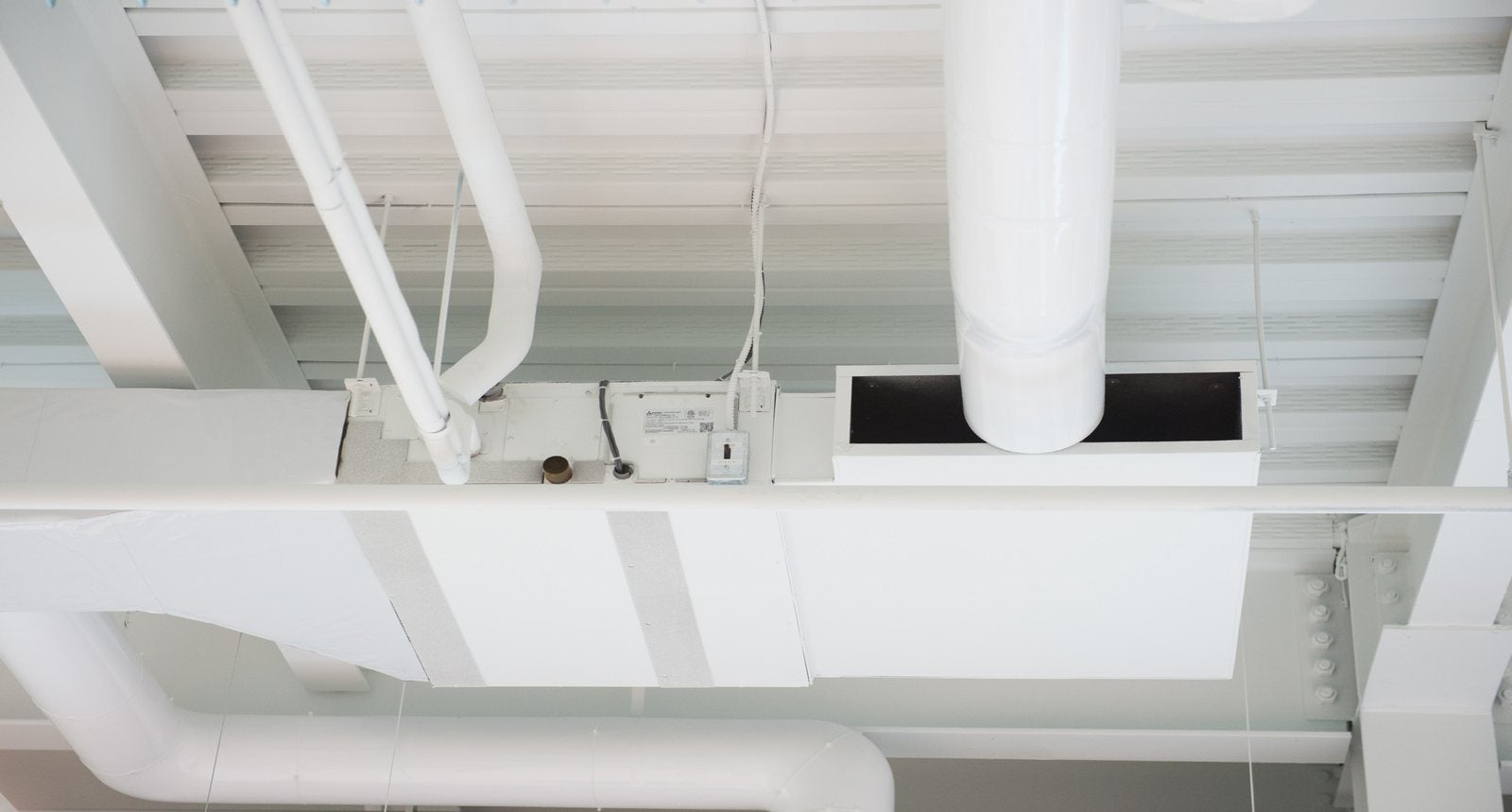
According to the CaGBC’s Zero Carbon Building Standard, the certification means the project modelled a zero-carbon balance for future operations, incorporated an efficient energy and ventilation system to meet a defined threshold for thermal energy intensity, and designed onsite renewable energy systems capable of providing a minimum of 5% of building energy consumption. The building was designed to not just maximize energy efficiency, but to actually create more energy than it consumes. As part of this mandate, all components needed to be energy-efficient, including the HVAC system.
“Our original vision was to design and build a building that was net positive energy at similar costs to conventional construction – and we were determined to prove it was possible.” Adrian Conrad, Chief Operating Officer, The Cora Group
The Solution
“Mitsubishi Electric Heating and Cooling products were selected right from the get-go during the design phase.” Syed Abid, Sales Manager, HVAC Division of Mitsubishi Electric Sales Canada
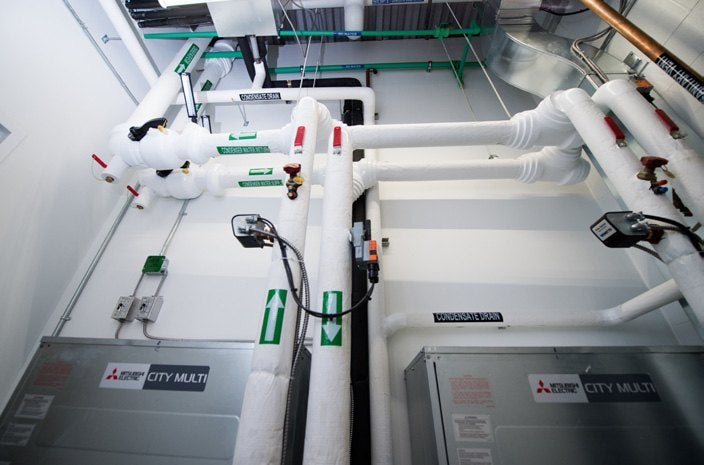
Since the CaGBC standards for a Zero Carbon certification specifically mention the HVAC system, Mitsubishi Electric’s energy-efficient heating and cooling systems were a natural fit. Mitsubishi Electric’s City Multi Water-Source VRF Heat Recovery System was chosen because it not only regulates the flow of refrigerant to the fan coils, but it also changes the water flow rate to minimize the pumping energy.
The Mitsubishi Electric heat pump system is also very quiet, and is a great solution for office, commercial, education and residential applications.
“Heat pumps move heat around instead of creating heat.” Fin MacDonald, Manager of the Zero Carbon Building Program at CaGBC
It is the most efficient way of heating the building – the source of the heat is warmer because you have a geothermal system pulling heat from the ground instead of air, which is cooler and needs more energy to move the same amount.
The Results
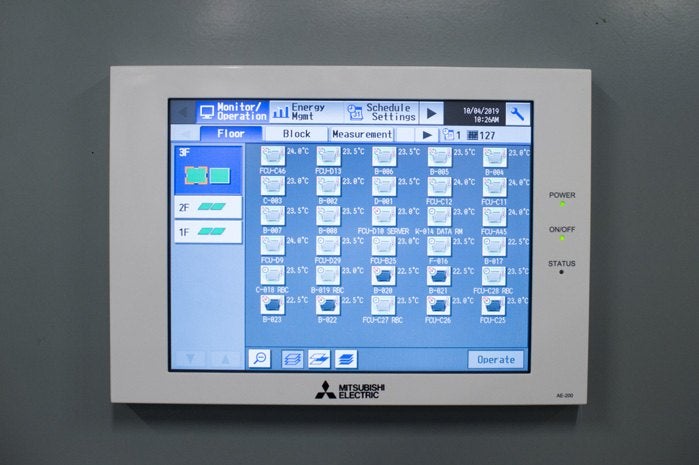
evolv1 attained its Zero Carbon Building-Design certification from CaGBC and has become a model for future developments.
MacDonald points out that zero carbon buildings are known to have energy, operational and maintenance costs savings. They also have a lower unoccupancy rate and more productivity, as the human experience is improved.
In fact, MacDonald says the upfront capital costs add only between 4% and 10% to the total, but lifecycle costs over 25 years come out neutral or under, meaning the upfront investment completely pays for itself or ends up making money.
Summary
Developer and Owner: The Cora Group Inc.
Distributor: Mits Airconditioning Inc.
Mechanical & HVAC Contractor: Conestogo Mechanical Inc.
General Contractor: Melloul-Blamey Construction Inc.
Architect: Stantec Architecture Inc.
Civil, Mechanical & Electrical Engineer: Stantec Consulting
Location: Waterloo, Ontario
Industry: Office
Size: 104,000 square feet, 3-storey building
Open loop geothermal integrated to Mitsubishi Electric’s Water Source VRF Heat Recovery System
Project Delivery Method: Design Assist
Challenges:
With an ambitious goal to achieve a zero carbon designation, the evolv1 building needed an innovative, eco-friendly HVAC system that used energy wisely.
Selection Criteria:
- Optimal thermal comfort and thermal zone control
- Lowest electricity consumption
- Lowest carbon emissions
- Geothermal energy compatible
- Cost-effective HVAC system
- Variable water flow rate VRF condensers
Design/Engineering Solution:
Mitsubishi Electric Outdoor unit models:
- 18 City Multi water-source VRF heat recovery (575V) condenser units
- 13 PQRY-P120ZLMU-A1
- 3 PQRY-P96ZLMU-A1
- 2 PQRY-144PZLMU-A1
Mitsubishi Electric indoor unit models:
- 148 City Multi ducted concealed ceiling-mounted indoor units (PEFY-P NMAU-E3, various sizes)
Results:
- Zero Carbon Building-Design certification from the Canada Green Building Council under ZCB standard
- Canada’s first zero carbon, net positive office building
- Consumes 30% less energy than industry norm
- Portfolio project for developers and team
- LEED Platinum Candidate
Frequently Asked Questions
How can an HVAC system support a zero carbon building design?
An energy-efficient HVAC system can help reduce electricity use and carbon emissions while supporting thermal comfort and zone control. In this project, Mitsubishi Electric’s water-source VRF heat recovery system was selected as part of the building’s strategy to achieve Zero Carbon Building-Design certification.
What are the benefits of combining geothermal energy with a water-source VRF system?
Combining geothermal energy with a water-source VRF system allows the building to use the more stable temperature of the ground as a heat source while efficiently moving heat throughout the building. The system can also vary water flow to help reduce pumping energy.
How much energy can a high-performance commercial HVAC system save?
Energy savings depend on the building and system design. In this case study, the completed office building consumed 30% less energy than the industry norm while achieving its zero carbon design goals.